Context & discovery
Deel is an HR platform SaaS where, among many other things, users can create employment contracts.
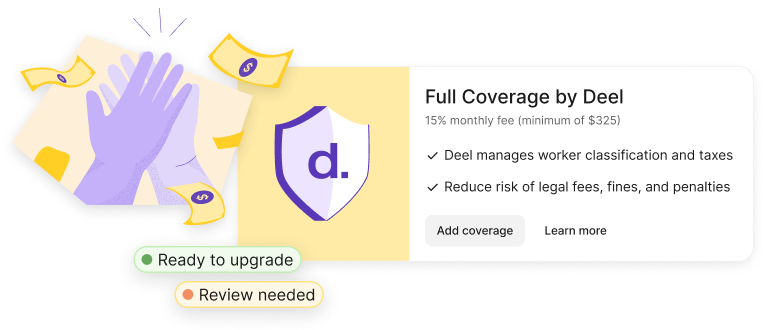
In Q1 2025, the experience of adding coverage to a contract made in Deel was fragmented.
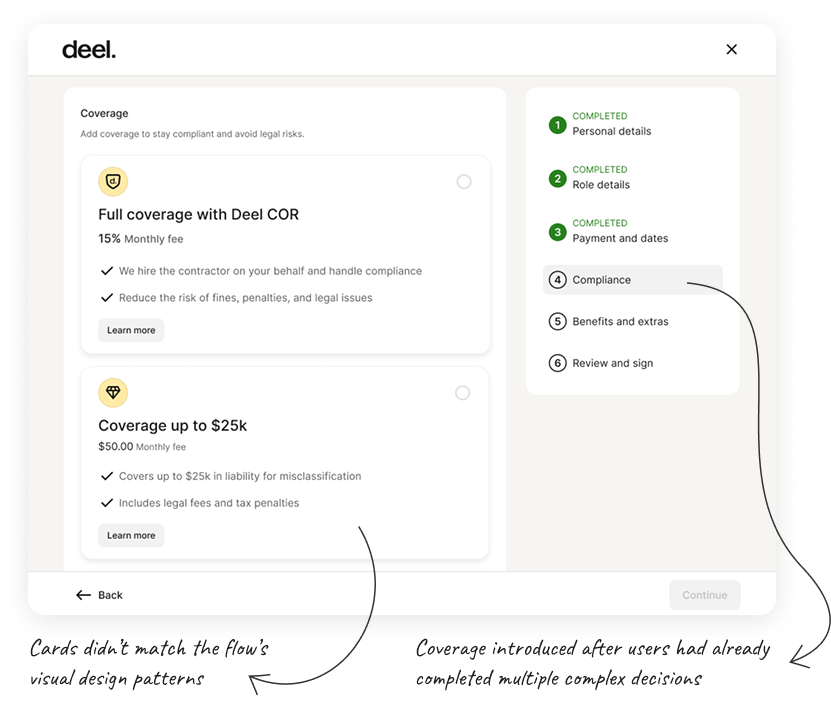
Coverage upsell happened too late in the flow, different coverage plans were difficult to understand, and there was no way to add coverage to multiple contracts.
Our team's main KPI was to increase revenue generated by our most premium coverage: Contractor of Record (COR).
 COR coverage
Deel offers different coverage options for contractors.
Contractor of Record (COR) is the most comprehensive option, in which Deel hires the contractor on the client's behalf and takes on legal and compliance liability.
 Research and AI
We conducted qualitative interviews with 10 clients who had recently upgraded at least one contract to COR, covering different organization segments.
The research had two parts:
- Exploration: understanding users' mental models, needs, and pain points.
- Validation: presenting an early prototype to test our assumptions.
To speed up synthesis, we used NotebookLM to summarize the source notes and surface recurring themes, which we then validated against the original notes:
My activities
- UX research script
- Interviewing and consolidating
How it was
Journey:
Coverage step:
Opportunity
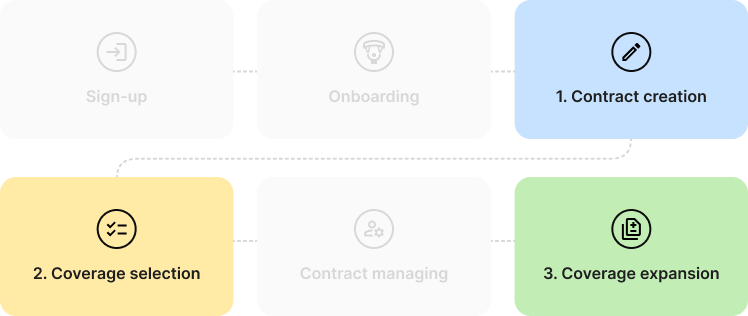
Aiming at increasing adoption and expansion revenue opportunities, I mapped the full coverage decision journey and ran an ideation session to identify opportunities.
We decided to redesign the coverage journey holistically across three critical moments:
 Ideation session
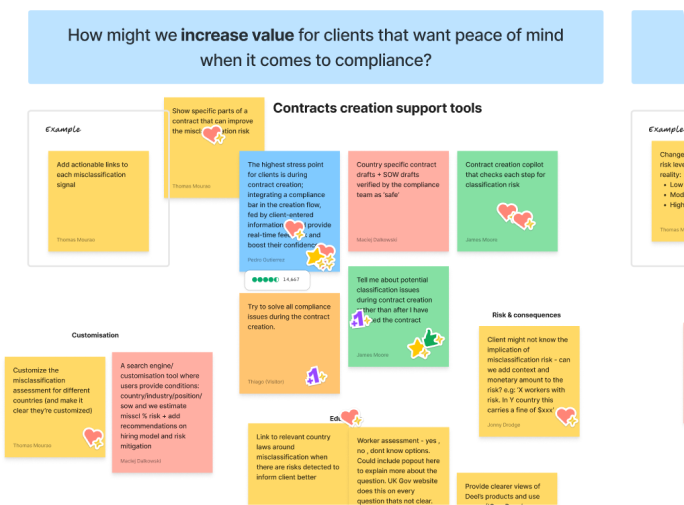
Based on the research findings, I facilitated an ideation session with the Product team:
- Context & framing
- Research findings
- Idea generation & clustering
- Voting & prioritization
My activities
- Set-up and facilitation of ideation session
- Defining direction with Product Manager
Initiative 1: Contract creation (AB test)
Problem
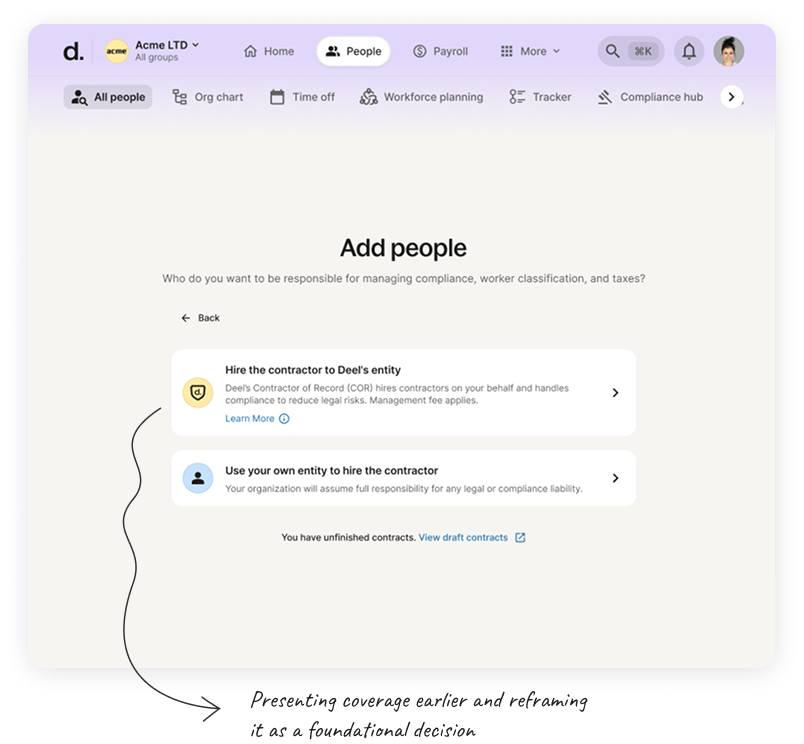
Coverage selection happened late in an already complex contract creation flow. By that stage, users were cognitively overloaded and less likely to engage with coverage decisions.
Hypothesis
By presenting coverage earlier and reframing it as a foundational decision, we'd improve understanding and increase conversion by aligning the decision with the user's initial hiring intent.
Solution
Journey:
Initial step:
Test results


My activities
- Benchmarking
- Design and prototype
- Close collaboration with engineering to understand limitations
Initiative 2: Coverage selection (AB test)
Problems
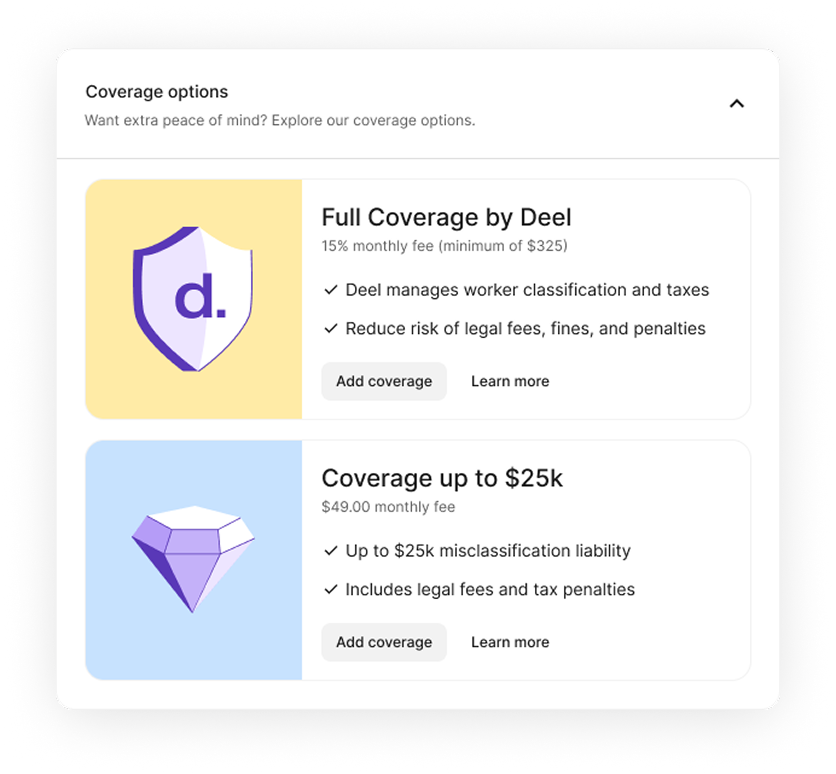
- Users struggled to understand the differences between coverage and hiring types.
- The visual design of the coverage cards didn't match the flow's patterns.
Hypotheses
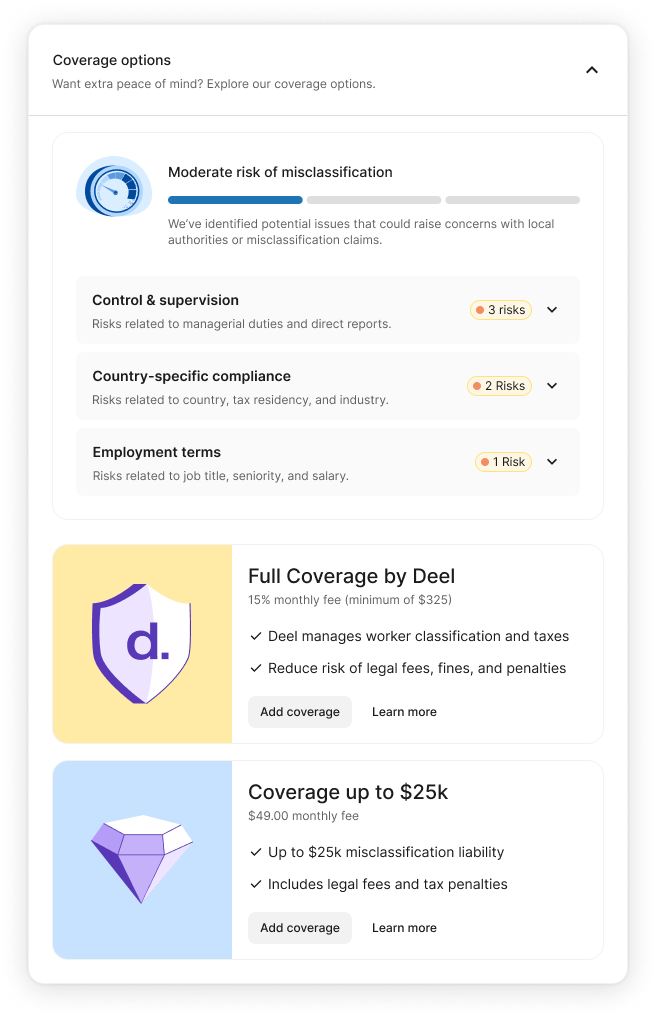
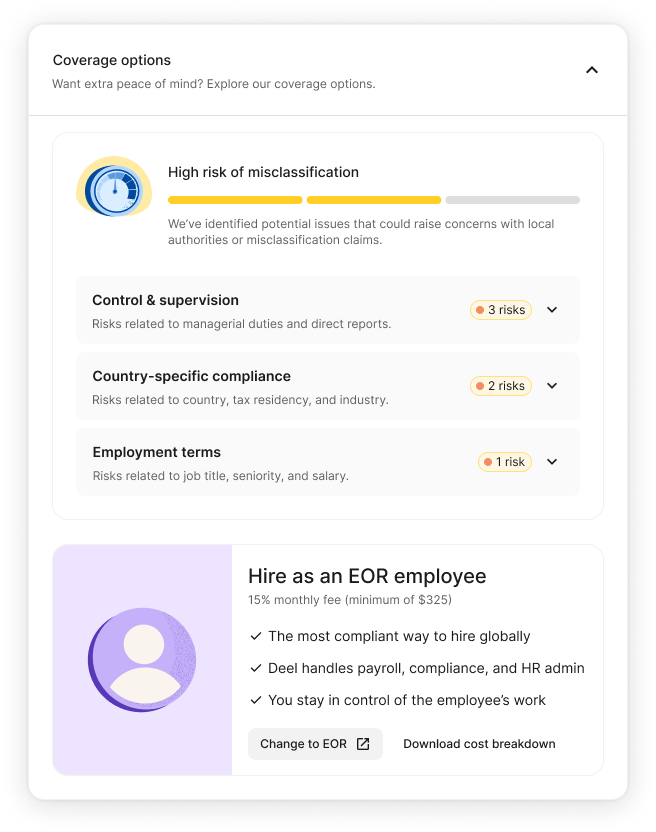
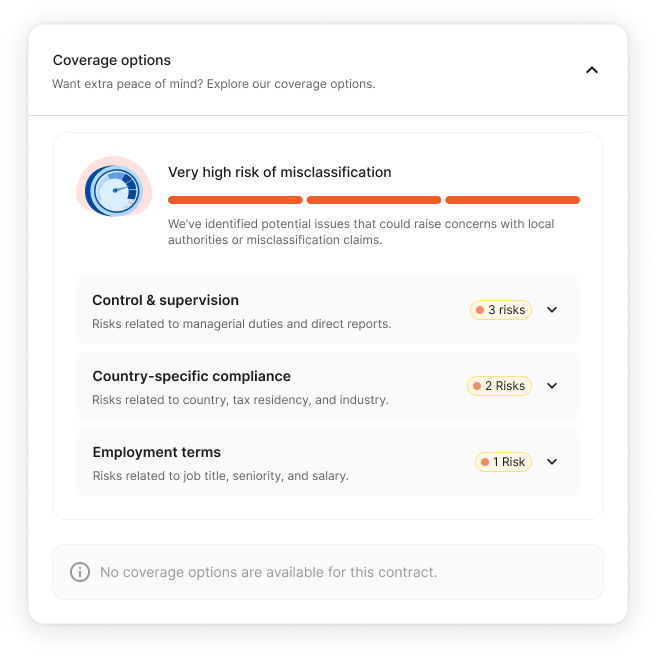
- By analizing inputted information, we'd be able to recommend more relevant coverage options.
- By re-structuring the coverage cards, we'd standardize information and increase coherence.
Solution
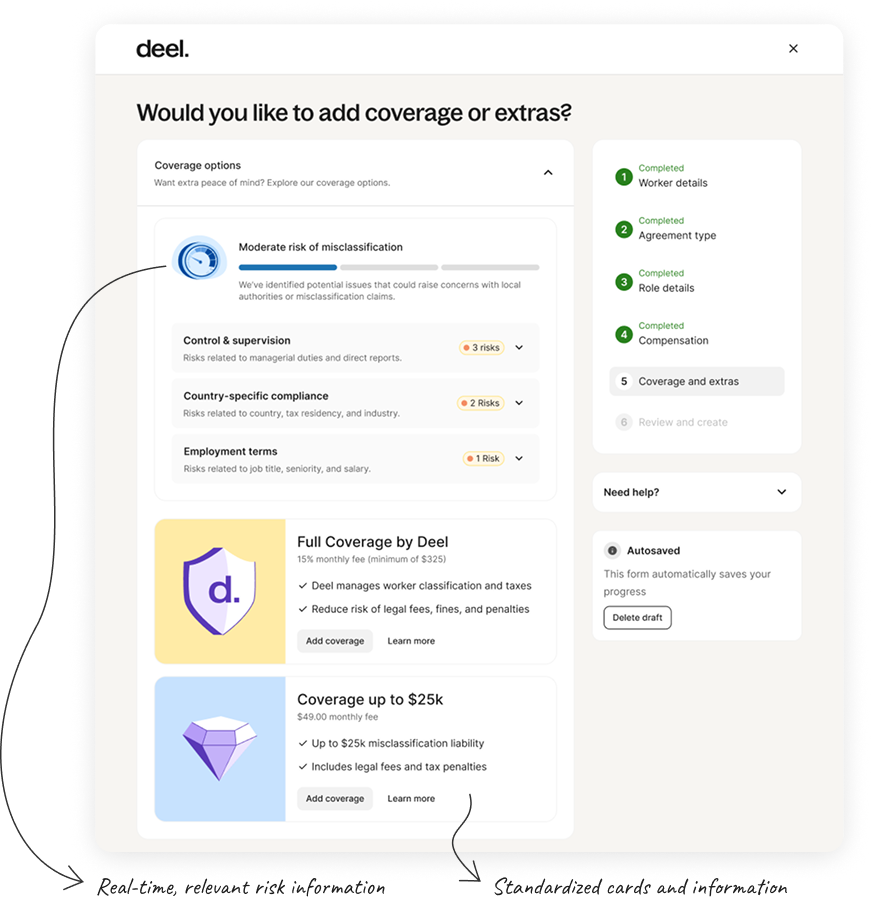
Risk levels
Select a risk level to see the design:
Test results
- Overall conversion: +3.4%
- COR conversion: -5%
- Estimated net revenue impact: -$5k
Though the variant was rolled back, this initiative created a foundation for modular experimentation and improved visual design.


Key learning
Users interpreted limited risk signals as reassurance rather than urgency:
"If there are only a few risks, I probably don't need full coverage."
Although the experiment underperformed, the work established a scalable experimentation framework for future recommendation models.
My activities
- Design and prototype
- Alignment with other owners of the flow
Initiative 3: Coverage expansion
Problem
Clients managing multiple contractors needed to add coverage to contracts individually, creating operational friction and increasing the risk of errors.
Hypotheses
- By creating a flow to add coverage to multiple contracts, we'd improve client's time efficiency.
- Allowing clients to assess eligibility and resolve blockers at scale would result in greater conversion.
Solution

Impact
Within 60 days of launch:

My activities
- Design and prototype
- Close collaboration with engineering to understand limitations